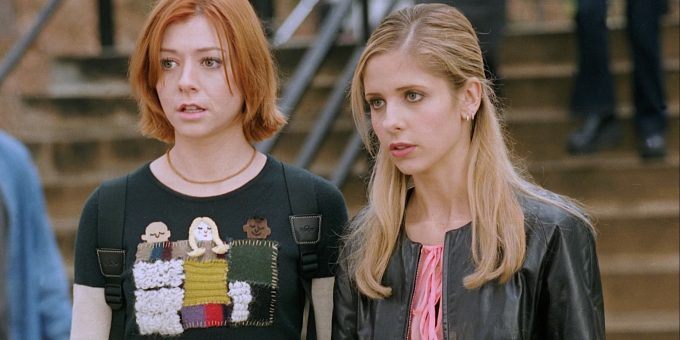

Buffy the Vampire Slayer Writer Reveals Major Developments On Upcoming Story
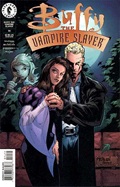
Buffy the Vampire Slayer and Angel fans were thrilled last year when it was revealed that Dynamite Entertainment was going to bring Buffy and Angel back to the world of comics, and not only that, but BOTH titles were going to be written by multi-Eisner Award-nominee for Best Writer, Kelly Thompson/
As Dynamite CEO and Publisher Nick Barucci said at the time, “Buffy the Vampire Slayer is truly one of the crown jewels of modern television, and comics fans know that she’s more than made her mark in this medium as well. The genius mix of its small-town vibes with fantasy and horror, the seamless touches of humor, incredible strong female characters that we’ve been proud to always represent at Dynamite – it all works together for a perfect set of characters and framework for stories. Including Angel! Which we’re excited to contribute to and build for new and returning fans.”
CBR was able to sit down with Kelly Thompson to discuss her rather secretive plans for Buffy and Angel, and what it means to try to do new stories for characters that haven’t been on TV in well over two decades.
CBR: You’ve always done a really nice job of coming up with unique takes on properties you’re workin on, most famously your Absolute Wonder Woman pitch. Is it different writing something like Buffy, which you’re such an extensive fan of?
Kelly Thompson: I do think it is sort of similar to Absolute Wonder Woman. I hadn’t really thought about that because they were very different journeys for me.
I’ve told the story a lot, so I won’t bore you, but with Absolute Wonder Woman I almost quit because I couldn’t figure it out. I was three or four days away from having to call Scott and say, “I can’t keep burning your runway. You’re got to fire me and find someone else because I can’t crack it.” That feels incredibly different from the Buffy and Angel situations, where my editor, Nate Cosby, came to me and said, ‘Hey, Dynamite has gotten this license for Buffy and Angel. I really want you to do one or both of the books.”
I immediately saud, “Well, I have an idea.” I’d been sitting on it for a while. It was ready to go.
But there are real similarities. If Scott Snyder, Chris Conroy and DC hadn’t liked the Absolute Wonder Woman idea, I think I would’ve just waled away. Looking back, that probably would’ve been a huge mistake because I’ve gotten so much joy and fulfillment out of doing it, but I really felt like, “I have a take. It’s good. I can see the vision. If you don’t want to do that, that’s totally fine, but I don’t want to try to find something else because it’ll just be lesser.
That was also true for Buffy and Angel. I told nate, “The good news is I’ve got a great idea, and maybe we can find a way to fit it into my schedule. I’d want to write both books because it’s one big idea. The bad news is, if we pitch this and they don’t like it, which is completely legitimate, and they don’t want to take these risks or go in this direction, then I’m out.” Not in a jerky way. Just in the sense that this is the idea.
Honestly, I’m kind of like that with pitches in general. A lot of writers I know and respect come up with a dozen different pitches. I never really do that. I usually have one idea. Maybe we tweak it or change aspects of it, but there’s almost always one core thing I’m really excited about.
I don’t know which approach is better because I’ve never lived on the other side of it. Part of me thinks it’d be amazing to have twelve great ideas. But I get really emotionally invested in these stories, so it doesn’t surprise me that I tend to lock onto one thing that I believe is the right way forward. It probably highlights both the strengths and weaknesses of my personality.
My partner always makes fun of me because I talk about “greatest strength, greatest weakness” all the time, but I really believe that’s true. The things you’re best at often leave you vulnerable in ways you never expect. So I think this is probably one of those situations. It’s a strength and a weakness, just like everything else.
It’s interesting you mention Absolute Wonder Woman because, from knowing you for so long, I know how into mythology you are. Similarly, now you’re coming into Buffy, where you already know all of that lore off the top of your head.
I was actually talking to Omar from Near Mint Condition about this the other day, and you helping me connect these two pitches is interesting. It really is sort of the same thing.
With Absolute Wonder Woman and with Buffy and Angel, I felt really confident, and a lot of that confidence comes from simply knowing the lore. I don’t have to go back and do the same level of due diligence. I have gone back and rewatched a lot of Buffy and even more Angel because I’ve seen Angel fewer times than Buffy.
With Wonder Woman, I’ve read a ton of the comics, and I’m a huge mythology fan. So there’s this little storehouse of knowledge in my brain that really helps when you’re trying to build something, especially when you’re planning long-tern. Absolute Wonder Woman is one of the first times I’ve really been able to plan long-term story arcs, A. B and C arcs that stretch way into the future. Honestly, I’m pretty pleased with how it’s working out considering nobody ever trained me how to do that. When I cam into comics, that wasn’t really something new writers got to do.
Buffy and Angel have a little of that same opportunity. We’re plotting further ahead than I normally would. Not like Absolute Wonder Woman, because that’s an incredible success that gives you a huge runaway. Buffy and Angel will have to earn however much runway we get. But we’re still planning some really big lore developments that I think fit into the Buffyverse in a really interesting way. The big changes are exciting, but what’s even more interesting to me are the ripple effects afterward. How do these changes affect these characters? How do they bring people together?
You’re right, though. I hadn’t really made that connection before. I always try to do my homework. On almost everything I’ve written, I’m at least somewhat of a fan, usually a very big fan. But with most properties there are decades of comics to reread and refresh yourself on. With Wonder Woman and Buffy and Angel, I come in with a bit of an ace up my sleeve because I just know this material really well.
I remember years ago you were pitching Marvel on a pretty obscure series, and that was definitely trickier.
Yeah
It’s funny you mention rewatching Buffy because, as amazing as that show is, when you watch it now the tone is very much of its era. I assume you’re not trying to recreate that exactly with these books.
It’s been very tricky. Honestly, if I didn’t know these characters as well as I do, it might be impossible. I’m hesitant to tell people I nailed it because they’ll definitely let me know whether I did or not.
You’re right, though. I don’t think you can just write it exactly the way it sounded in 2000. That was twenty five years ago. If you can do that, it’s going to sound dated and out of sync with the world. I don’t necessarily think everything I write has to be trying to predict what’s next, but you always want to be pushing forward.
So the challenge became making sure I still had these characters’ voices while gently updating them. You don’t want readers to hit a joke and suddenly have that record-scratch moment where they think, “That doesn’t sound right.” So how do you make Willow still sound like Willow while acknowledging that this is 2026 instead of 2000.
Because it’s not meant to be a period piece.
Exactly. We don’t put dates on anything. Maybe if we show an Angel flashback to 1790 you’ll see a date, but we’re not saying, “Het, it’s 2026,” or “It’s 2000.” We’re treating it the same way the television show did. You might see a cell phones or things like that, but we’re not making a point of placing it in a specific year.
So far, I think it’s working. I will admit that the first arc has an element that naturally keeps some of the everyday life out of the story a little bit, so maybe it’ll become more challenging later. But honestly, I hope we nailed it.
At this stage it’s a weird feeling because the work is finished. It’s being printed. There’s no changing anything anymore, but nobody has seen it except the people internally working on it. You’re left wondering, “Did I hit a home run, or did I completely screw this up?” I genuinely don’t know.
I’m proud of it. I feel really protective of these characters and this world. I think I would know if I’d completely failed them. But in the end it’s going to be up to the readers to tell us how close we got.
I love the Buffyverse, so I really hope we did it justice. I’d hate to add something to it that fans felt was underwhelming. I hope we’re bringing something genuinely exciting to it. We’ll see.
It’s interesting you mentioned how you’re opening up with the crossover. So how do Buffy and Angel relate to each other in that sense? Is it like the old Superman Triangle era where it’s one story across two books, or are they still distinct books within the bounds of this crossover?
For the first arc, which is five issues of each book, and both Number Ones are a little oversized, they’re pretty interlocked. The first two issues are dramatically interlocked. I’ve started describing Buffy #1 and Angel # as almost like a two-part pilot.
Gotcha.
The big reveals, well, I guess multiple reveals, but one in particular, happens in Buffy #1. But Angel #1 really depends on that context. You need Buffy to understand everything everyone is dealing with when you get to Angel #1.
From Issue #2 onward, the books split up a little bit. Basically, think of it like a home team and an away team. They have different missions.
Buffy Gold Team and Buffy Blue Team?
I almost did that, by the way. There are just so many characters that it became less confusing to call them the home team and the away team because one group is staying closer to Sunnydale and the other is operating farther away. Not Los Angeles though.
The teams also won’t be split entirely along Angel and Buffy lines. Mostly, but not completely. That’s for two reasons. One is simply plotting. That’s what the story needs. The other is that I wanted the characters to mix a little. I wanted some Angel characters dealing with Sunnydale and Buffy characters, and I wanted some Buffy characters having to deal with Angel’s side of things. Not just because that’s fun for me as a writer, but because that’s something we lost once Angel got its own television show.
Right. Cordelia never really came back.
Exactly. As a fan, you’re excited because suddenly you get two shows instead of one. That’s amazing. But you don’t necessarily realize at first that they’re not really going to be smashed together anymore. We don’t have that problem. We have the opposite problem.
At the same time, if you don’t want your artists showing up at your house in the middle of the night to murder you, you probably shouldn’t have them drawing twelve major characters together on every page. You have to break them up a little and be smart about it. Honestly, I don’t think readers would want that either. It would just be overwhelming. Let’s be real, there are a lot of white girls in this cast who look a little similar. Let’s save all our lives and split them up a little.
It’s funny you mention the size of the cast because whenever a book has this many fan-favorite characters, sometimes the lead almost winds up taking a back seat. But Buffy has always managed to avoid that. What do you think makes Buffy able to remain the focus despite having such an incredible supporting cast?
If I could figure out why Buffy is, and I’m just going to say it, one of the greatest lead characters in any ensemble story ever, I’d probably be pretty rich.
I almost never connect most strongly with the lead character. I like them, of course, but I usually end up gravitating toward the side character, the misfit, the comic relief, the weird one, the truth teller. Those are almost always my favorites. Your Spikes and your Cordelias. But Buffy never had that problem. I honestly don’t know what the secret ingredient is. Maybe it’s the writing. Maybe it’s Sarah Michelle Gellar. Maybe it’s the combination of the two. But she never felt like a protagonist who was trapped by being the protagonist.
Lead characters usually get all the dramatic material. They get the big love stories and all the major plots, but because they’re carrying every storyline, they often don’t get to be funny enough or flawed enough. Buffy somehow avoids all of that. There’s this perfect balance in the writing and in Sarah Michelle Gellar’s performance where you just love that girl. You want her to win in a way I almost never feel about the lead character.
Not to get even deeping into my own narcissism, but I wrote Storykiller years ago, and Buffy was absolutely the guiding star for how I tried to write Tessa. I wanted her to have that same quality. I don’t think I quite got there. I love Tessa. I think she’s a great character. But I don’t know that readers who love Storykiller feel about Tessa the way I feel about Buffy. That’s a really difficult thing to pull off.
It’s difficult here, too. You would think having Buffy already established would make it easy, that you just pick up the baton, but I actually think it’s trickier than that. I also think the way we’ve structured this story helps support Buffy in that role, so we’ll see.
If I knew exactly what made Buffy work as well as she does, I’d be trying to use that formula everywhere.
One of the tricky things with licensed books is that fans know every tiny detail. I remember when Dynamite launched the Supernatural comics and people immediately started saying, “Well, it can’t happen at that point in time because of XYZ,” or things like that. At the same time, this is a show that hasn’t had a new television episode in twenty years, so you also have to make it accessible to new readers. How do you balance serving both audiences?
I don’t know.
That’s honestly the answer. We tried our best. I hope we got there.
I was actually telling somebody recently that I prefer the Angel #1 script to the Buffy #1 script. I’m not saying it’s the better issue. They’re doing different jobs. The Buffy script has to carry so much weight. It has to introduce all these concepts to readers who already know this world inside and out while also hopefully bringing in new readers who might just know Buffy by reputations and think, “I like vampire stories. Maybe I’ll try this.” That’s an enormous amount of heavy lifting.
Poor Stephen Byrne had an incredibly difficult assignment. The first issue has so much referencing and flashback material, and that’s before you even get into the likeness issues. I think Stephen and Giulia Giancomino have both done an amazing job with that. They also get better every issue, which isn’t surprising. Once you’ve drawn these characters for a while, you naturally settle into them.
But if all you’re looking for is somebody who can draw a likeness, you’re not going to make great comics. You need storytellers. You need artists who can sell emotion, action and character. Stephen and Giulia both do that really well.
Angel #1 doesn’t have to carry all of that setup because Buffy has already done the heavy lifting. Angel gets to deal with the ramifications. At that point, whether you’re a longtime fan or a brand-new reader, you either buy into the concept or you don’t.
You’re right about the fandom, though. I keep saying in interviews that Buffy fans are incredibly smart, and I don’t think people realize I’m being completely sincere. It’s exactly like what you’re describing with Supernatural. These are people who know this lore as well as I do. If you casually mention something, people immediately start putting the pieces together.
I think our idea is really creative and interesting, but I also think that if enough people sat down and compared notes, they could probably figure it out. In fact, I saw one guy on Reddit get dangerously close, and I joked with Nate that we needed to stop doing interviews because this guy was going to solve the whole thing.
It’s been a fun little cat-and-mouse game. I hate being cagey because I’d much rather just talk openly with people, but I also think that if we can preserve the surprise, even if only until somebody inevitably leaks it the week before publication, readers will enjoy discovering it for themselves.
It reminds me of Better Call Saul, where people figured out the hidden message in the episode titles after only a few weeks.
Exactly. Say what you will about whether you loved or hated Lost, but imagine trying to write something where you’ve got millions of people on the internet working together to figure out every twist before you get there. We don’t have that level of attention, thank goodness, but it’s still intense. It’s my one little brain trying to hide enough information so the masses can’t figure it out before the books come out.
I assume, then, that with all of that in mind, we’re not really looking at any connection to the old Dark Horse comics, right? Obviously, no offense to those books.
That’s right, and of course, no offense to any of those comics, most of which, maybe all of which, I’ve read. There are probably some deep-cut spin-offs I never got to because there were a lot of books.
They did do a LOT of spin-offs.
They really did. There was a Spike book, an Angel book, all sorts of books for a while. If you read those and loved them, that’s fantastic. If you read them and hated them, that’s fine too. The good news for us is that you don’t have to worry about any of that continuality. All you really need to know is the television show. We’ve gone to great lengths in Buffy #1 to lead readers by the hand. Even if you don’t really know the show and all you know is, “I like vampire stories, maybe I’ll try this,” we wanted to make sure you could still come to the book comfortably.
No disrespect to any of the previous comics, but we wanted to keep the lore simple. Honestly, I couldn’t even tell you exactly how all of those comics connect because some of them do and some of them don’t. The Dark Horse books continue the television series. Other books are reboots. Some are alternate futures. There are a lot of different continuities. We wanted to keep things straightforward. The parts I needed all came from the show, and I don’t think you can reasonably ask readers to keep track of decades of comics that have moved between publishers with different creative teams and different continuities. That’s already too much. It’s already a big ask t say, “Hey, remember this television show you loved twenty-five years ago? Here’s a comic.” I’m very aware that’s already asking a lot.
It makes me think about your Star Wars work. That’s a decade old now, isn’t it?
Oh my God. I was just interviewed about Captain Phasma for a Star Wars book, and the woman who reached out… nobody wants to talk to me about Captain Phasma right now because everybody wants to talk about Absolute Wonder Woman, which is great, obviously. But she wanted to talk about Phasma, and I was so excited because I love that book. People talked about it a little when it came out, but not nearly as much as I would’ve liked. It’s drawn by Marco Checchetto. It’s awesome.
That was a really cool book.
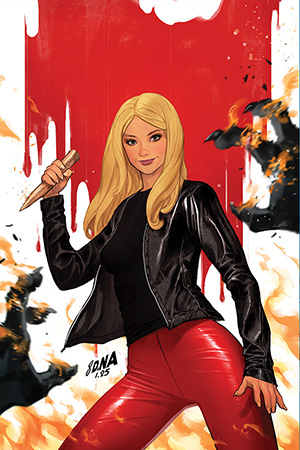
Speaking of these new books, you mentioned that the first issues are oversized. How great has it been seeing the amount of support Dynamite has put behind this project? Not just the extra pages, but the big covers, having David Nakayama doing covers, Stephen Byrne on Buffy. It has to feel good to have the company putting that much behind it.
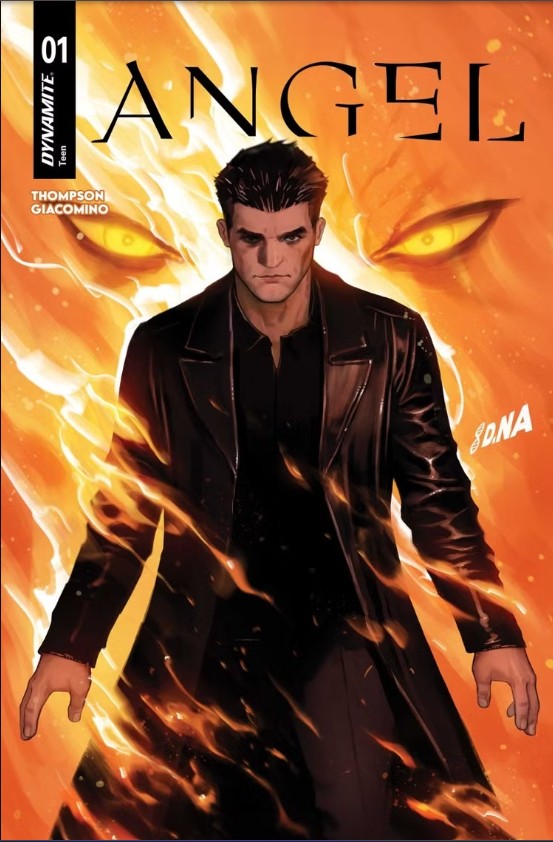
It really does. They genuinely believe this can be a big book. I think that’s because of the creative team they’ve assembled. Stephen, Giulia… I know Giulia is relatively new, but readers are going to be really impressed.
I’ve seen some of her Dynamite work before. She’s really talented.
She’s fantastic. She’s doing a wonderful job with the likenesses. They’re different from Stephen’s but they’re both really good. Like I said, they both get better every issue, which has been really fun to watch. I feel like Stephen’s likenesses by Issue #3 are just incredible.
But likenesses alone aren’t enough. If you’re only hiring someone because they can draw somebody’s face, you’re not necessarily making a great comic. You need artists who can tell stories, communicate emotion, handle action and pacing. Stephen and Giulia both do that really well.
Dynamite has been incredibly supportive. I actually feel a little guilty because I’ve had to hide so much, and that makes it difficult for them to promote the books.
I guess I just feel like once I stop trying to preserve the reading experience, at what point am I no longer really being a writer? At what point do I just become part of the marketing campaign? To be clear, nobody at Dynamite is asking me to do that. They’ve been incredibly supportive, even though I’m constantly saying, “Nope, can’t talk about that. Nope, can’t show that cover. Nope, redact that.”
There’s an Angel #1 cover that recently came out with this giant black box covering part of it. At first I didn’t even realize it had been redacted. I was looking at it thinking, “Why does this cover look so strange?” Then I saw the unredacted version and immediately understood. I actually felt bad for the artist because people are seeing this cover without realizing what it’s really supposed to look like. I’m not even sure keeping everything hidden is necessarily the right approach, but that’s where we are.
It reminds me of the conversations people have about AI and writing. Why would you want to take away part of what makes writing fun? One encouraging thing about the current comics is that readers have shown they’re willing to support second printings now. We see that all the time with the Absolute books. That’s a big change from even five or six years ago.
Absolutely.
And that’s really helpful for books like yours where there are major twists early on. Readers hear about them afterward and can still jump in without feeling like they’ve completely missed the boat.
Yeah, definitely. One thing we realized while we were figuring out the release schedule was that once Buffy #1 is out, we’re basically free.
I was actually wondering about that when you mentioned the FOC. So Angel #1 really is coming out a good bit after Buffy #1.
Yeah. I think Buffy comes out around July 22, and Angel is around August 19.
Right. August 26 is a Wednesday, so that sounds about right [It was here that I explained to Kelly that I had just done an article about a comic book coming out on August 26th, which is why I had that date handy. She was impressed by my seemingly bizarre ability to know offhand what dates in August were Wednesdays]
Exactly. Once Buffy is out, everything changes. The big status quo shift becomes public, and Angel #1 is all about the ramifications of that change. By the time San Diego Comic-Con rolls around, everybody will know what happened, so we can finally talk about it openly. Hopefully that gets even more eyes on the books from people saying, “Okay, now I want to see what that’s about.”
It also means we can finally reveal the redacted covers. Meredith McClaren did these beautiful covers for Angel, and there’s a regular version and a redacted version. They’re gorgeous. I honestly want to marry those covers. I can’t wait for people to finally see them.
I should probably stop looking at it from the negative perspective and start looking at it as exciting that we’re keeping this surprise intact. That’s probably a much healthier way to think about it.
Something else that strikes me about Stephen Byrne and Giulia Giancomino is that they obviously have very different styles, but thy’re both really good at conveying personality. For a book like this, that almost feels more important than anything else.
It really is. The likenesses are important to me. I want them to feel dead-on because, honestly, I usually stay away from licensed books where likenesses matter this much. As both a fan and a writer, Buffy is really the exception because if they don’t look like these characters, then it’s just another vampire comic. That’s perfectly fine, but it’s not what I’m trying to make.
I’m interested in these specific people. I want to know what these characters look like when they’re crying because they’re world has fallen apart. That’s what matters to me. You’re right, though. The emotions are key. I think Stephen and Giulia are both outstanding storytellers. There’s plenty of action in these books, but everything really lives in the expressions on their faces and what they’re able to communicate while still maintaining the likenesses.
One thing we’re doing to help tie the books together is having Lee Loughridge color both series. Even though Stephen and Giulia have different styles, I actually think doing likeness work naturally brings them a little closer together visually. Then Lee helps create even more consistency between the books.
I’m also excited about what happens after Issue #5, once the books separate a bit more. Angel starts becoming more like the television show again. We get to spend more time in Los Angeles, and I get to bring in Wesley and Gunn, who are two of my favorite characters. They’re a little sidelined in this opening arc simply because we already had too many characters to juggle. Even the color palette will evolve a little once the books become more distinct, but during this first storyline we’re really leaning on Lee’s work to help unify everything.
It’s funny you mention Lee because just the other day, knowing we were talking today, I was thinking about how much I love his work. Every time I interview someone whose book he colors, I always wind up talking about how incredible he is. I actually wondered whether I’d complimented him enough over the years because the way he uses color to define emotion is just remarkable.
He’s incredible. People who have worked with me probably know this, but I’m a complete nightmare when it comes to colors. I’m very particular. Part of the problem is that, even though I’ve been trying to improve, I don’t always have the vocabulary to explain exactly what I want. I actually tried to get Jordie Bellaire to give me a crash course in color terminology so I’d know how to communicate better.
Right. Just learning the language.
Exactly. What words should I actually be using?
For a long time, I felt like my tastes were really out of step with modern coloring. So much contemporary coloring is incredibly bright and shiny. Every surface reflects light. Everything is super saturated. That’s just not really my thing.
There are books where that absolutely works. On Captain Marvel, for example, it felt appropriate to make everything bright and energetic. Sarah Brunstad, who edited Captain Marvel and later Black Widow with me, and I had a lot of conversations about that.
With Lee, thought, I think what’s special is how flexible he is. I’m sure he could do that bright, glossy superhero style if he wanted to, but that’s never what I think of when I think of Lee’s work. I think of mood. I think of atmosphere. I think of colors that support the emotional tone of a scene rather than simply reflecting what objects are supposed to look like.
Grass doesn’t always have to be bright green. Sometimes it should be something else because that’s what the emotional moment calls for. Is the color choice coming from the emotion of the scene, or is it only there because there’s supposedly a neon light nearby? I’m much more interested in the emotional version. I’m not looking for the bluest sky or the greenest grass you’ve ever seen. Superhero comics often push in that direction, and I don’t really gravitate toward it.
I also don’t want to create the wrong expectation of these books because they’re still Buffy and Angel. They’re not suddenly Hellboy. But visually, I’m probably more interested in that kind of moody atmosphere than bright superhero spectacle. It still has to acknowledge that Buffy began as a teen drama, but I think Lee has been enormously helpful in finding that balance.
One last questions before I let you go. My wife and I were visiting a friend yesterday and her daughter, and we were talking about how my wife and this friend originally met through X-Files fandom back in the old Television Without Pity days. As somebody who was a Buffy fan back then and now gets to write Buffy, how strange is it looking at fandom today compared with what it was when you were watching the show? Or is it really just the technology that’s changed while the fandom itself is basically the same?
That’s a really interesting question. I don’t know that I have a perfect answer because I think once you cross over from being purely a fan into being someone who’s creating the work, your relationship with fandom changes.
I actually think about this a lot because I probably read more reviews and online discussion about my books than a lot of creators do. I don’t know whether that’s a good choice or a bad one. Some of it is probably just narcissism or insecurity. You’re naturally curious about what people are saying about your work. But I also genuinely learn things. There have been literal examples where I was writing Rogue & Gambit and somebody mentioned something on a message board that made me stop and think, “Wait… what’s that?” Then I went digging through old comics and realized they were right. It wasn’t that I’d gotten something wrong, but they’d pointed me toward a path I hadn’t even considered.
So there are practical reasons to stay engaged with fan discussion, and then there are broader reasons, too. Take Absolute Wonder Woman. When we introduced Absolute Zatanna, you obviously hope people are going to be excited, but you really don’t know. You’re writing in a vacuum. Then readers react in a big way and suddenly you realize, “Okay, they’re interested in this. Maybe there are more stories here. Maybe we should keep exploring this direction.” I don’t think it’s automatically wrong for creators to pay attention to fan reactions. It might not always be great for your mental health, but I honestly think it’s been good for my writing. At the end of the day, I’m always going to prioritize whatever I think makes me a better writer.
All of that actually reminds me of something from when I was watching Buffy. When Dawn first showed up…
Wait.. I thought Dawn had always been there {retcon laughs}
When that happened, I remember thinking, “That’s ridiculous. Buffy doesn’t have a sister. They’re just shoving this into the show.” This was one of my favorite television shows, and I still had absolutely no faith that they actually had a plan. So I always try to remember that fans don’t know what’s coming. They’re not sitting where I am. They don’t know everything we’ve been planning for months. I wish fans would give creators a little more grace sometimes, especially in comics where you’re asking people to judge a story one issue at a time even though the complete picture might not exist for another six months. But at the same time, I also have to remember that I was exactly that fan. I had no faith that one of my favorite television shows knew what it was doing.
It’s the same thing. I tell a similar story about when Scott Snyder announced Dick Grayson was becoming Batman. My immediate reaction was, “No. That’s ridiculous. Bruce Wayne is Batman.” Then Scott wrote The Black Mirror, which is one of my favorite Batman stories ever. Sometimes you just have to stay open-minded.
I think that’s a really good place to end. “Give people grace” is a pretty nice message.
And I want to give the fans grace, too.
There you go. Okay, thanks so much, Kelly.
Thank you.
Buffy the Vampire Slayer #1 is on FOC this Monday.
Original article at CBR